
Power source
We check whether your unit's panel has room, or whether a house or garage panel is the better source.
Want to charge in your condo garage? Get a plan your association can approve, wired from the right panel to your space.
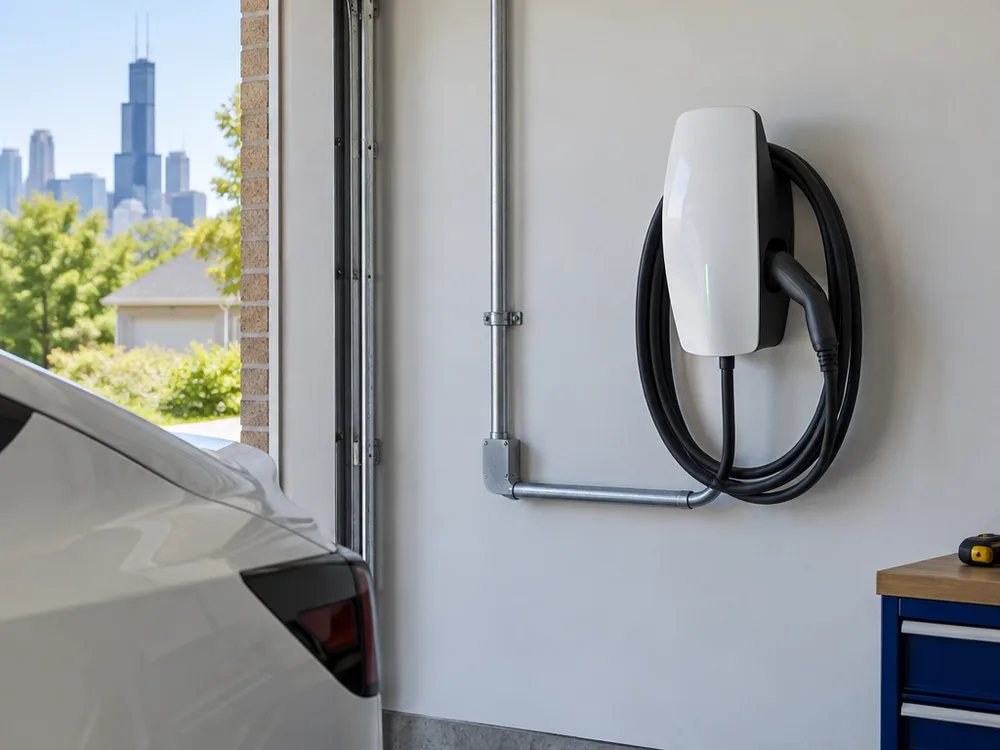
Charging in a Chicago condo is less about the charger and more about the building. The circuit may start at your unit's panel or a house panel, the route may cross common areas, and the board will want to see the plan before anyone drills.
We start by finding where power can come from and how it will be metered, then put together a written scope your association can review: route, equipment, insurance and who pays for what.
Once the board signs off, the install itself follows the same steps as any electric car charger installation, with extra care around common areas and fire separations.
The Illinois Electric Vehicle Charging Act took effect January 1, 2024. Under it, an association can't unreasonably restrict an owner from installing or using a charger in a deeded or designated parking space, though health, safety and other local rules still apply.
If the association requires an application, it has to approve or deny it in writing within 60 days. If it doesn't respond, the request is treated as approved unless the board reasonably asked for more information.
This is a summary, not legal advice. Your declaration and bylaws matter too, so share them with us early.
We check whether your unit's panel has room, or whether a house or garage panel is the better source.
Charging can be on your own meter, a submeter or a charger that tracks its own use. Each affects how the electricity gets billed.
Conduit is routed and supported to the building's standards, with fire-rated penetrations sealed where walls or floors are crossed.
If neighbors will want charging too, load management can let several chargers share capacity without a building service upgrade.
Under the Act, an association can require you to follow its architectural standards, use a licensed and insured electrical contractor who provides a certificate of insurance, and carry your own liability coverage naming the association, depending on where the charger goes.
Owners generally pay for the installation, the electricity used, any damage to common areas, and maintenance or removal later. For a condo EV charger installation, we put the equipment and route in writing so the board has what it needs to decide.
New buildings are different. Chicago now requires EV-ready parking in new residential construction, so newer garages may already have a circuit waiting for a charger.
We work in condo and townhome buildings across Chicago and nearby suburbs.
Call (773) 801-7276 to talk through your building.
Under the Illinois Electric Vehicle Charging Act, an association can't unreasonably restrict charging in a deeded or designated space. It can set reasonable conditions on safety, insurance and appearance.
Usually the owner. The charger can be wired to your unit's meter, or the building can use a submeter or the charger's own usage tracking.
The Act gives the association 60 days to respond in writing once it has a complete application. A clear scope helps avoid back-and-forth.
Yes. Load management lets multiple chargers share capacity, which is often cheaper than upgrading the building's service.
Tell us about your building, your parking space and where the nearest panel is. We'll put together a condo EV charger scope your association can review.